
Fundamentals of AI Research (FAIR) Programme
Every AI tool you’ve used, from the photo app that recognises faces to the chatbot that answers your questions, began as a model that someone built, trained and tested. FAIR shows you how that happens, from the inside. You’ll learn what the code is actually doing, and how researchers decide whether a model is any good.
What you’ll learn
FAIR takes you through seven modules in three stages:
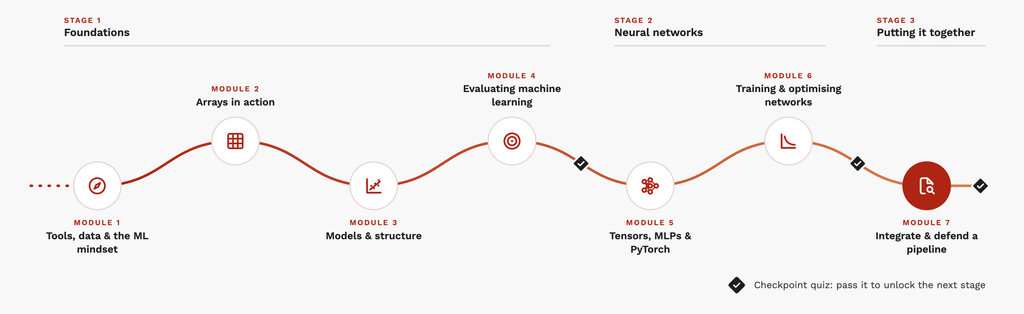
- Foundations (Modules 1–4). Learn how machines learn from examples, and get comfortable with the tools researchers use every day. Build your first models to predict values, sort examples into categories and find patterns in data. Then learn the most important research skill of all: telling whether a model really works on data it has never seen.
- Neural networks (Modules 5–6). Build a neural network piece by piece, then train one to read handwritten digits. Watch it learn epoch by epoch, diagnose what goes wrong, and run your own fair experiment to test an idea.
- Putting it all together (Module 7). Read a real AI research paper, improve a model by deciding whether the data or the model is holding it back, and keep a research logbook on GitHub, just as working researchers do.
Along the way, you’ll learn to check whether a model’s results can be trusted, and to spot when biased data makes a model unfair to some groups.
Why it’s worth it
By the end, you’ll be able to:
- build a complete machine learning project, from raw data to a tested, improved model
- explain what’s happening inside the tools you use, instead of treating them as black boxes
- track down and fix bugs in your own machine learning code
- read a research paper and pick out what the authors did and what they found
These are the foundations for studying AI at university, and for taking on research questions of your own.
How it works
Each module pairs reading on the course page with hands-on work in Google Colab notebooks, which run in your web browser, so there’s nothing to install. Every exercise has hints and a worked solution in case you get stuck, and short checks along the way tell you when you’re ready to move on. You work at your own pace, whenever suits you.
How much time you’ll need
Plan for about 30 to 36 hours in total. The course runs from 21 October to 18 November, so that’s about 7 to 9 hours a week. Modules 5 and 6 are the longest, so leave extra time for them.
How do you seek help?
The FAIR team is here to support your learning. You should attempt to troubleshoot the issue yourself first by referring to the Troubleshooting FAQ below. If the issue is still unresolved, please reach out to us: https://tinyurl.com/FAIRhelpline.
Acknowledgements
FAIR was developed by AI Singapore with the guidance of the following Academic Advisors. We are grateful for their time, expertise, and advice, which helped shape the programme’s scope, rigour, and approach. Any remaining errors are our own.
- Hady W. LAUW, Associate Professor of Computer Science, Singapore Management University
- Min LEE, Assistant Professor of Computer Science, Singapore Management University
- Roy Ka-Wei LEE, Associate Professor of Computer Science, University of British Columbia (Okanagan)
- Christian VON DER WETH, Senior Lecturer (Educator Track), National University of Singapore
- Pan ZHOU, Assistant Professor of Computer Science, Singapore Management University
Curious how machines learn? Let’s begin!